How the Earth Was Formed

The formation of the Earth started 4.6 billion years ago from planetesimals that formed through accretion and gradually formed into planets. This is known as the core accretion model and it is where the Earth started.
Click below to go to the main reviewer:
Table of Contents
- How Earth Formed Its Layers
- How the Moon Formed and What Caused the Tilt in the Earth’s Axis
- How Life on Earth Started
- Download Article in PDF Format
- Test Yourself!
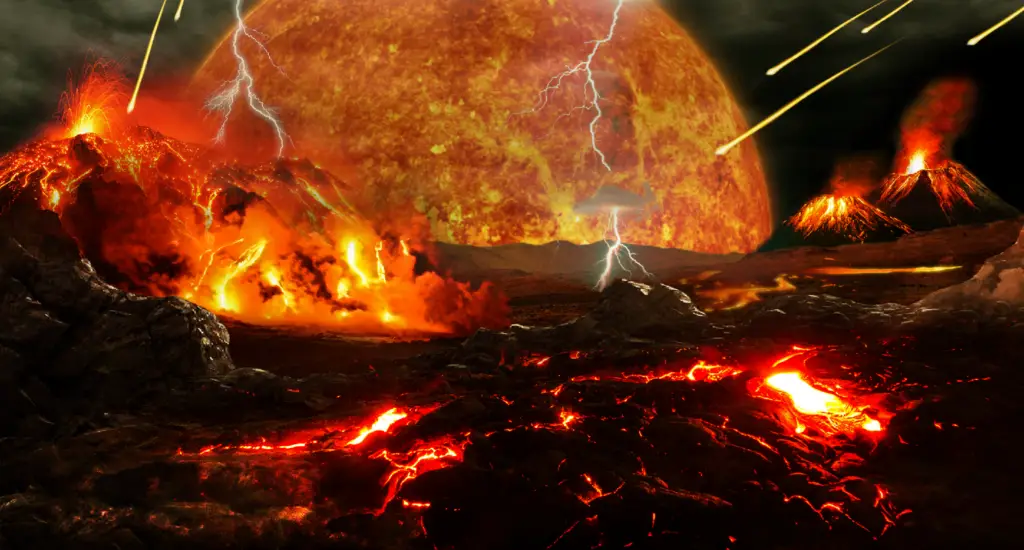
Because of the constant bombardment of space bodies and the decay of radioactive elements, the early Earth was dominantly molten. As time passed, bombardment declined and the temperatures began to cool.
How Earth Formed Its Layers
Heavier elements like iron and nickel sank to the center of the Earth forming the core, while lighter elements migrated towards the surface. This allowed the Earth to produce layers in a process called chemical differentiation. It is during this cooling period where the Earth’s primitive crust started to form and the magnetic field was produced.
How the Moon Formed and What Caused the Tilt in the Earth’s Axis
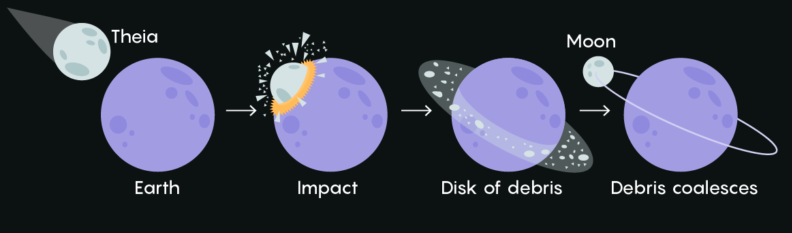
The Giant Impact Hypothesis states that around 4.5 billion years ago, a large Mars-sized celestial body called Theia impacted the Earth which resulted in the ejection of undifferentiated Earth materials, forming our Moon.
The impact is also said to have been the cause of the tilt in the Earth’s axis.
How Life on Earth Started
Around 4.37 – 4.20 billion years ago, Earth was bombarded by asteroids in a period known as the Late Heavy Bombardment stage. It is theorized that these asteroids carried atmospheric, oceanic, and biological components such as water and bio-elements, which set the stage for life on Earth.
As the Earth cooled, the outgassing of gases (via intense volcanism) from the Earth’s interior formed Earth’s first atmosphere. Unlike now, the first atmosphere was very hot and mostly composed of gases such as NH3, CH4, CO2, and a bit of H2O.
Around 4.0 billion years ago, water vapor in the atmosphere began to condense which produced torrential rains that formed our vast oceans.
Cyanobacteria (a type of aerobic bacteria) played an important role in the production and increase of O2 in the Earth’s atmosphere. Because of this, aerobic bacteria began to thrive while anaerobic bacteria declined in an event called the Great Oxidation Event.
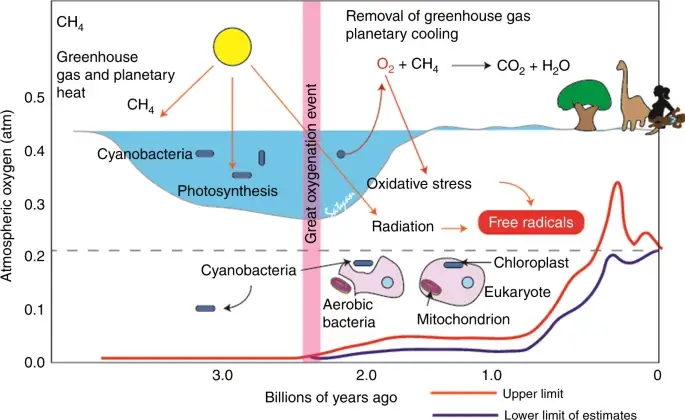
Accelerated weathering of the Earth’s surface introduced elements such as Na, Ca, K, and Si from the land to the oceans, increasing its salinity. Seawater and CaCO3 in the oceans “locked up” large amounts of CO2 in the atmosphere, cooling the Earth significantly.
Next topic: The Motions of the Earth
Previous topic: The Solar System and its Planets
Return to the main article: The Ultimate Astronomy Reviewer
Download Article in PDF Format
Test Yourself!
1. Practice Questions [PDF Download]
2. Answer Key [PDF Download]
Written by Ruth Raganit

Ruth Raganit
Ruth Raganit obtained her Bachelor of Science degree in Geology from the University of the Philippines – Diliman. Her love affair with Earth sciences began when she saw a pretty rock and wondered how it came to be. She also likes playing video games, doing digital art, and reading manga.
Copyright Notice
All materials contained on this site are protected by the Republic of the Philippines copyright law and may not be reproduced, distributed, transmitted, displayed, published, or broadcast without the prior written permission of filipiknow.net or in the case of third party materials, the owner of that content. You may not alter or remove any trademark, copyright, or other notice from copies of the content. Be warned that we have already reported and helped terminate several websites and YouTube channels for blatantly stealing our content. If you wish to use filipiknow.net content for commercial purposes, such as for content syndication, etc., please contact us at legal(at)filipiknow(dot)net