DID YOU KNOW Bayani “Yannie” Rumbaoa? The Filipino Artist Who Engraved the Nation’s Legacy into Every Coin.
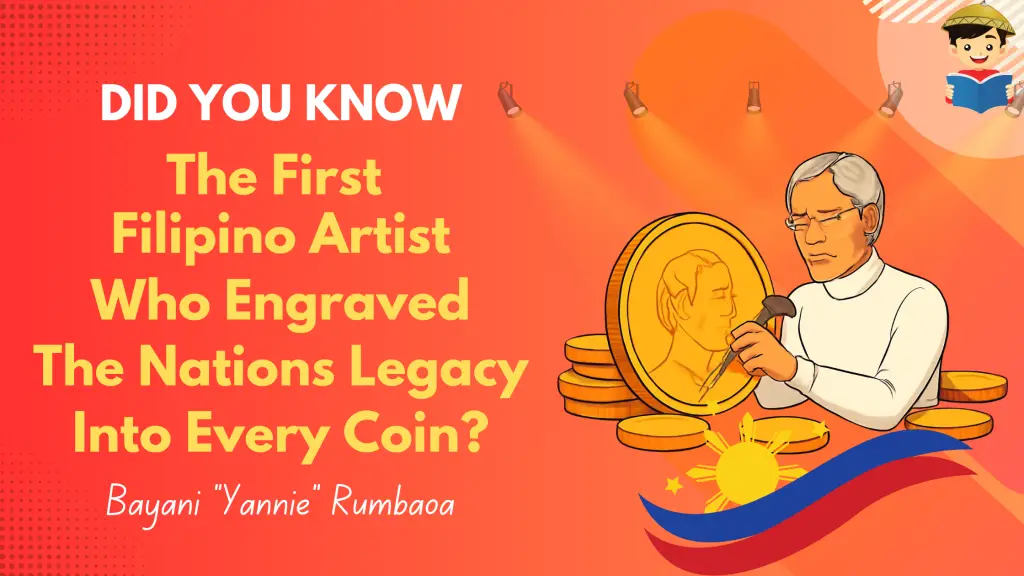
Meet Bayani “Yannie” Rumbaoa
The Filipino Artist Who Engraved the Nation’s Legacy into Every Coin.
In this article, you will learn about Bayani “Yannie” Rumbaoa, the Father of the Philippine Coin, whose artistic excellence and dedication left an indelible mark on the nation’s history.
Table of Contents
WHO IS THIS MAN?
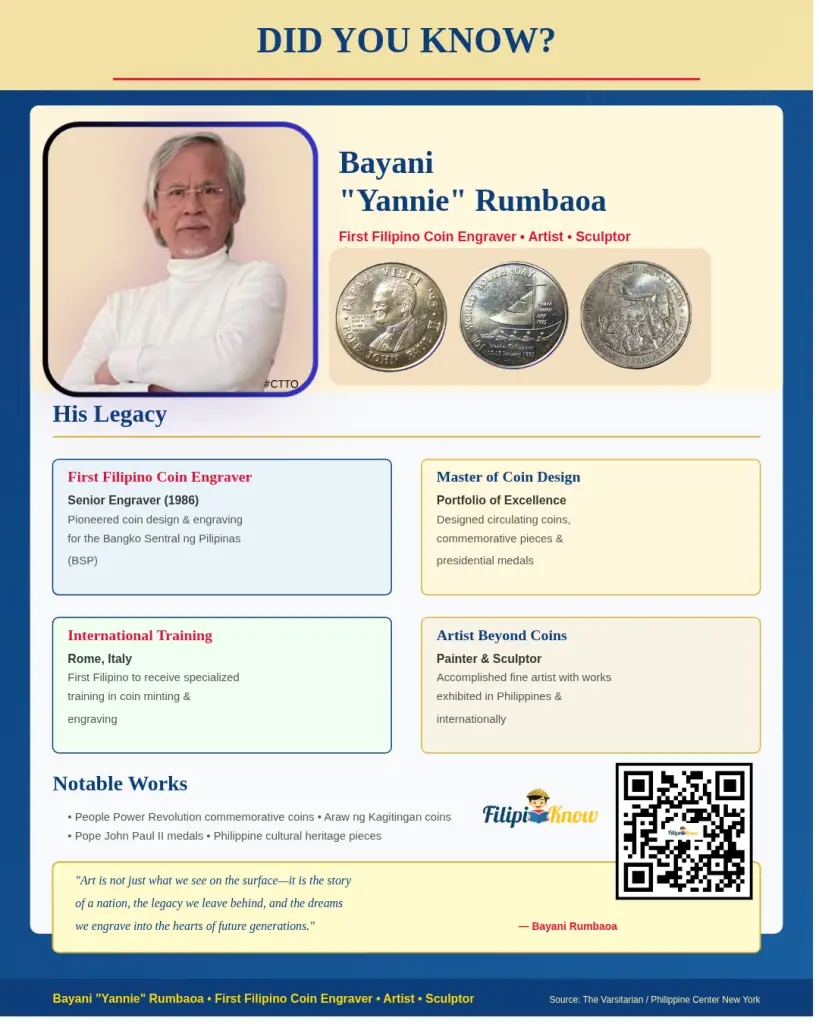
Bayani “Yannie” Rumbaoa is a Filipino artist, painter, and sculptor who holds a profound place in Philippine history—not just for his artistic talents, but as the first Filipino Coin Engraver of the Bangko Sentral ng Pilipinas (BSP). Born and raised in Manila, Philippines, Rumbaoa has become a living symbol of how passion, perseverance, and artistic excellence can transform a nation’s identity, one coin at a time.
Affectionately called the “Father of the Philippine Coin” by those who recognize his monumental contributions, Rumbaoa spent over three decades serving the Philippine government as the Master Engraver of the central bank—creating the designs that every Filipino has held in their hands thousands of times without knowing the genius behind them.
EARLY LIFE: FROM HUMBLE BEGINNINGS TO ARTISTIC DREAMS
Rumbaoa’s journey was far from privileged. Coming from a financially struggling family, he worked various jobs while pursuing his passion for the arts. Despite the hardships, he remained committed to his dream of becoming an artist—a determination that would later define his entire career.
His determination paid off when he was accepted to the University of Santo Tomas (UST), one of the Philippines’ most prestigious universities. In 1983, Rumbaoa graduated with a Bachelor’s degree in Fine Arts, majoring in Painting. This Thomasian education became a cornerstone of his identity and artistic philosophy—values of excellence, service, and dedication that he carried throughout his professional life.
What made his achievement even more remarkable was that he accomplished this while working to support himself and his family, embodying the Filipino spirit of determinasyon and sipag.
CAREER: PIONEERING EXCELLENCE IN COIN DESIGN & ENGRAVING
First Filipino in International Coin Training (1980s)
Rumbaoa’s career took a historic turn when he became the first Filipino to undertake specialized training in coin minting and medal design. Breaking barriers and international precedent, he was selected as one of only 12 foreign scholars to attend the prestigious Art of Medal and Coins training at the Istituto Poligrafico E’Zecca Dello Stato Scuola Dell’Arte Della Medalla in Rome, Italy—the world’s leading institution for coin and medal design.
This training was transformative. In Rome, he studied under master engravers who taught him the ancient yet exacting techniques of bas reliefs, direct metal engraving, and the delicate art of creating designs that would stand the test of time. The Italian masters shaped not just his technical skills, but his artistic philosophy—that coins are not merely currency, but historical documents, cultural statements, and works of art.
Service at the Bangko Sentral ng Pilipinas (1986–2021)
In 1986, Rumbaoa joined the Bangko Sentral ng Pilipinas as a senior engraver and ultimately rose to the position of Chief Engraver and Master Engraver. For more than 35 years, he carved the prototypes and designed nearly every Philippine coin that circulated through the hands of millions of Filipinos.
His responsibilities extended far beyond routine engraving work:
- Circulating Coins: He designed and engraved the Philippine peso coins in regular circulation, ensuring that everyday transactions carried artistic integrity.
- Commemorative Coins: Rumbaoa created special commemorative coins honoring pivotal moments in Philippine history, cultural heritage, and national figures.
- Presidential Medals: He engraved medals honoring Philippine presidents and national leaders, preserving their legacies in metal.
- Historic & Cultural Pieces: His works included coins commemorating the People Power Revolution, Araw ng Kagitingan (Day of Valor), papal visits, and Filipino cultural heritage.
In 2011, demonstrating his enduring connection to his alma mater, he was appointed by the UST Office of Alumni Relations to produce the Quadricentennial Commemorative Medallion honoring the university’s 400th anniversary since its founding in 1611.
He continued taking extensive courses in bass relief sculpture and advanced metal engraving techniques, including specialized training in 1993. His dedication to continuous learning made him not just an engraver, but a scholar of the craft. He retired from the BSP in 2021, leaving behind an unparalleled legacy.
BEYOND THE COINS: ARTIST, PAINTER & SCULPTOR
What many don’t realize is that Bayani “Yannie” Rumbaoa‘s artistic genius extends far beyond government service. He is an accomplished painter and sculptor in his own right, with a distinctive style that blends abstract and figurative elements.
His Artistic Vision
His paintings are vibrant, symbolic works that evoke feelings of love, unity, and hope—themes deeply rooted in Filipino identity. Rumbaoa has developed a recognizable artistic signature: he uses triangles shaped like fish heads as his personal mark in his artwork—a detail inspired by his daily encounters with fish vendors at Navotas Fish Port in 1980, which he frequented with his wife, Rowena Soriano-Rumbaoa.
This trademark represents a beautiful truth: that great art often springs from the simple, everyday moments and the people we encounter. The fish vendors of Navotas became immortalized in his artistic vocabulary.
Solo Exhibitions & Public Recognition
Rumbaoa has held multiple solo exhibitions showcasing his depth as an artist:
- His “3 Decades of Passion” exhibition at the BSP Security Plant Complex (June 2017) showcased 32 of his finest works, featuring paintings and bas relief engravings inspired by his Italian professors. He donated the proceeds to assist an infant patient needing a liver transplant—demonstrating his commitment to service beyond art.
- His works have been exhibited not only in the Philippines but internationally, including at the Philippine Center New York, where his “ALAMAT” (Legend) solo exhibit drew attention from art enthusiasts and collectors worldwide.
- He was featured at the Gateway Art Fair 2025, spotlighting him alongside other celebrated Filipino artists and recognized as a contemporary master of his craft.
CONTRIBUTIONS: ENGRAVING HISTORY INTO METAL
Cultural & National Legacy
Bayani Rumbaoa’s contributions transcend artistic excellence. He has been instrumental in:
- Establishing Filipino Identity in Currency: Before Rumbaoa, the Philippines relied on foreign expertise for coin design. His pioneering work proved that Filipinos could master this sophisticated craft and bring Filipino sensibilities, history, and cultural pride into the very coins that represent the nation’s economic and cultural identity.
- Democratizing Fine Art: By transforming coins into portable galleries, Rumbaoa made fine art accessible to every Filipino—from children receiving their first peso to businessmen conducting million-peso transactions. Ordinary commerce became an opportunity to appreciate artistic excellence.
- Preserving Historical Memory: Through his commemorative coins and medals, Rumbaoa created permanent metallic records of pivotal moments—the People Power Revolution, heroic sacrifices on Araw ng Kagitingan, papal visits, and the contributions of national figures. These coins become historical artifacts for future generations.
- Mentoring & Knowledge Transfer: As Chief Engraver, Rumbaoa trained other artists at the BSP, passing on the techniques and artistic discipline he learned in Rome. He ensured that Filipino expertise in coin design would continue beyond his tenure.
- Advocating for Artist Welfare: In public reflections, Rumbaoa has spoken about the importance of social security and benefits for artists—drawing from his own experience as a government employee with GSIS benefits, highlighting the vulnerability of struggling artists in the Philippines.
WHY BAYANI “Yannie” RUMBAOA IS RELEVANT TODAY?
In an era of digital transactions and cryptocurrency, one might assume that traditional coin engraving is obsolete. But Bayani “Yannie” Rumbaoa’s relevance today is perhaps more profound than ever:
1. Reclaiming Filipino Pride in Craftsmanship
Rumbaoa represents a Filipino who mastered an ancient, elite craft and brought international prestige to the Philippines. At a time when many young Filipinos aspire to work abroad, his story says: “Excellence in traditional crafts is not obsolete—it is uniquely Filipino.”
2. Art as Economic & Cultural Currency
As the Philippines seeks to strengthen its cultural soft power and creative industries, Rumbaoa’s example shows how artists can serve national development. His work proves that art is not a luxury—it is essential to national identity.
3. Bridging Tradition & Innovation
While coins may be supplemented by digital payments, Rumbaoa’s legacy bridges traditional metalwork with contemporary artistic expression. Collectors, historians, and numismatists still treasure his designs, and his paintings continue to attract art enthusiasts globally.
4. The Value of Perseverance & Sacrifice
Coming from poverty and working his way to mastery, Rumbaoa embodies the Filipino virtue of determinasyon. His journey inspires young Filipinos to pursue excellence in their chosen fields despite obstacles.
5. National Museum & Heritage Value
The Bangko Sentral ng Pilipinas’ Money Museum houses thousands of coins and medals designed by Rumbaoa. These represent not just currency, but cultural artifacts of immense historical and artistic significance—attracting researchers, collectors, and tourists.
6. Role Model for Filipino Artists
In recent years, as Rumbaoa has returned to active participation in the art community—exhibiting at major galleries, mentoring younger artists, and engaging with cultural institutions—he serves as a living reminder that artistic excellence is a lifelong pursuit.
A LEGACY ENGRAVED IN METAL & MEMORY
Bayani “Yannie” Rumbaoa’s story is one of quiet mastery. While most Filipinos who’ve spent coins bearing his designs never knew his name, he worked with meticulous dedication, ensuring that every transaction, every commemorative moment, every coin held the weight of artistic integrity and national pride.
He proved that Filipino artists can achieve world-class excellence. He showed that traditional crafts remain relevant in modern societies. And he demonstrated that true artistic service means creating beauty that ordinary people—not just elites—encounter daily.
As the Philippines looks toward the future, Bayani Rumbaoa’s legacy reminds us that our most profound achievements are often those we hold in our hands without fully recognizing them—until someone tells us the story of the artist behind the craft.
Bayani “Yannie” Rumbaoa: First Filipino Coin Engraver. Master Artist. National Treasure.
REFERENCES
Bunye, T. (2017, June 18). Lessons of the past. Sun.Star, Manila, Philippines. Retrieved from https://www.sunstar.com.ph/more-articles/bunye-lessons-of-the-past
Gonzales, J. C. (2025, September 24). Coffee, watercolor, coins: Meet the Filipino artists of Gateway Art Fair 2025. Rappler. Retrieved from https://www.rappler.com/life-and-style/arts-culture/filipino-artists-gateway-art-fair-october-2025/
Philippine Center New York. (n.d.). ALAMAT: Solo exhibit. Retrieved from https://philippinecenterny.com/alamat-solo-exhibit/
Rumors, T. (2016, October 4). Tibaldo: My friend Chiquito and the struggling Filipino artists (last of a series). Sun.Star. Retrieved from https://www.sunstar.com.ph/more-articles/tibaldo-my-friend-chiquito-and-the-struggling-filipino-artists-last-of-a-series
Ugnayang Sining Tomasi. (n.d.). Yannie Rumbaoa. Retrieved from https://ugnayangsiningtomasi.wixsite.com/sining/yannie-rumbaoa
Unidentified Author. (2025, February 7). Mayor Michael Keon welcomes Yannie Rumbaoa for courtesy meeting. North Luzon Politiko. Retrieved from https://northluzon.politiko.com.ph/2025/02/07/mayor-michael-keon-welcomes-yannie-rumbaoa-for-courtesy-meeting/social-snitch/
Other Articles: 8 Amazing Facts About Philippine History You Never Learned in School
Written by Joanne Borja
in Facts & Figures, History and Politics, Juander How, Nostalgia, People and Places, Today I Learned, World Records
Last Updated

Copyright Notice
All materials contained on this site are protected by the Republic of the Philippines copyright law and may not be reproduced, distributed, transmitted, displayed, published, or broadcast without the prior written permission of filipiknow.net or in the case of third party materials, the owner of that content. You may not alter or remove any trademark, copyright, or other notice from copies of the content. Be warned that we have already reported and helped terminate several websites and YouTube channels for blatantly stealing our content. If you wish to use filipiknow.net content for commercial purposes, such as for content syndication, etc., please contact us at legal(at)filipiknow(dot)net