The Layers of the Earth and its Composition
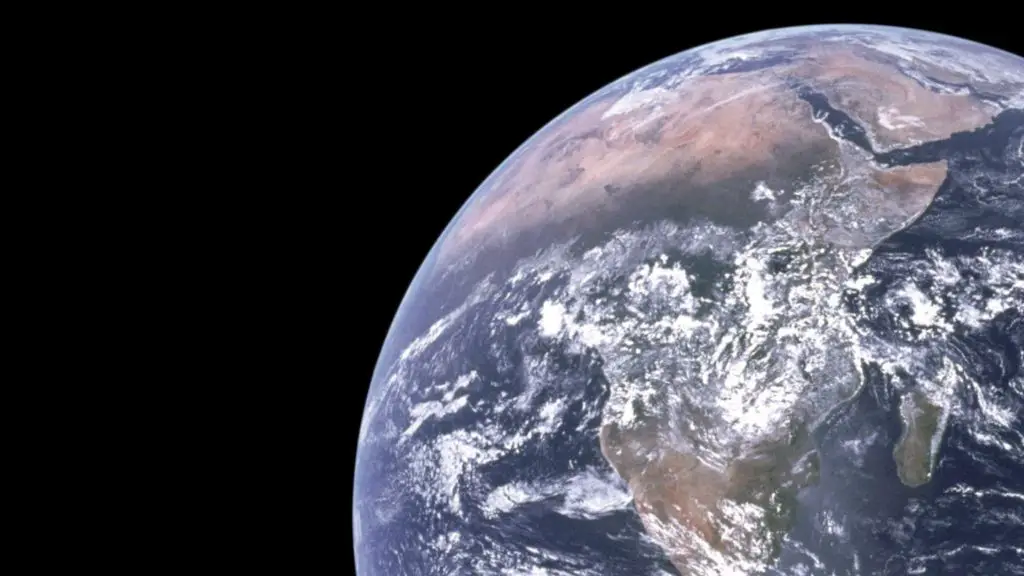
The Earth can be subdivided into layers based on two criteria: (1) composition (density) differences and (2) physical properties.
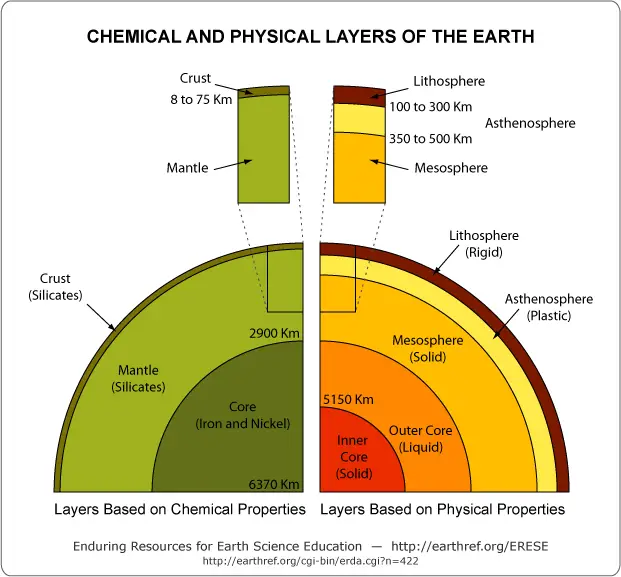
I. Based on compositional differences
1. Crust
This is the thinnest and outermost layer of the Earth. There are two types of crust– the continental crust and the oceanic crust.
The continental crust is the older and more buoyant type of crust. It has an average thickness of 35 km, but can be more than 70 km thick in mountainous regions. It has an average composition consisting of granite with a density of 2.7 g/cm3.
The oceanic crust is the younger and denser type of crust. It has an average thickness of 7 km, much thinner than the continental crust. It is composed of basalt, dark igneous rock with a density of 3.0 g/cm3.
2. Mantle
The mantle comprises the majority of the Earth’s volume (more than 80%) and begins where the crust ends, down to a depth of 2,900 km.
The boundary between the crust and mantle is called the Mohorovičić discontinuity, which is marked by a change in chemical composition.
It can be divided into two parts: the upper mantle and the lower mantle, separated by the Repetti discontinuity.
3. Core
The core begins at the mantle-core boundary, the Gutenberg discontinuity, located at the 2,900 km depth.
Although no one has ever been to or sampled the core, scientific investigations led to the conclusion that its composition is made up of a Fe-Ni (iron and nickel) alloy.
Due to its composition and the pressure conditions at depth, it is calculated to have a whopping density of around 11 g/cm3.
Click below to go to the main reviewer:
II. Based on Physical Properties
1. Lithosphere
The lithosphere (from the Greek word lithos meaning “stone”) is a thick and brittle layer that comprises the entire crust and uppermost layer of the upper mantle.
It has an average thickness of 100 km but can reach up to 300 km in the thickest portions of continents.
2. Asthenosphere
The asthenosphere (from the Greek word asthenēs meaning “weak”) is a mechanically weak layer consisting of the lower portion of the upper mantle, extending down to 660 km.
Contrary to popular belief, it is not a “sea of molten rock”. The upper mantle is actually composed of an Mg- and Fe-rich rock called peridotite.
At this depth, the temperature and pressure conditions are high enough that rocks become ductile and deform easily. Because of this, the asthenosphere flows more like very, very viscous fluid (but remember: it is not liquid!) and moves independently from the overlying lithosphere. This is a very important mechanism for plate tectonics (which will be discussed later in more detail).
3. Mesosphere
Beneath the asthenosphere is the mesosphere (from the Greek word mesos meaning “middle”), made up of the lower mantle, and reaches down to the 2,900 km depth.
The dominant rock type in this layer is a silicate rock called perovskite.
Unlike the asthenosphere, the mesosphere is much stronger and flows with more resistance. Because of the immense pressure from the overlying layers, the strength of this layer increases with depth.
4. Outer Core
Unlike all the other mechanical layers, the outer core is the only one made out of liquid— melted Fe-Ni alloy, to be exact.
The liquid nature of this layer can be attributed to extremely high temperatures (more than 3000°C!) that melt Fe, Ni, and all other elements.
The flow of the liquid metals is responsible for the Earth’s magnetic field. The outer core terminates at a depth of 5,150 km, where the solid inner core begins. The outer-inner core boundary is also known as the Lehmann discontinuity.
5. Inner Core
Despite the extreme temperature, the overwhelming pressure in this layer forces the inner core to be a solid ball of mostly Fe.
Temperatures in the inner core are similar to the temperatures of the surface of the Sun— around more than 5400°C.
Next topic: Minerals
Previous topic: Earth’s Vital Statistics and Earth Systems
Return to the main article: The Ultimate Earth Science Reviewer
Download Article in PDF Format
Test Yourself!
1. Practice Questions [PDF Download]
2. Answer Key [PDF Download]
Written by Ruth Raganit

Ruth Raganit
Ruth Raganit obtained her Bachelor of Science degree in Geology from the University of the Philippines – Diliman. Her love affair with Earth sciences began when she saw a pretty rock and wondered how it came to be. She also likes playing video games, doing digital art, and reading manga.
Copyright Notice
All materials contained on this site are protected by the Republic of the Philippines copyright law and may not be reproduced, distributed, transmitted, displayed, published, or broadcast without the prior written permission of filipiknow.net or in the case of third party materials, the owner of that content. You may not alter or remove any trademark, copyright, or other notice from copies of the content. Be warned that we have already reported and helped terminate several websites and YouTube channels for blatantly stealing our content. If you wish to use filipiknow.net content for commercial purposes, such as for content syndication, etc., please contact us at legal(at)filipiknow(dot)net